
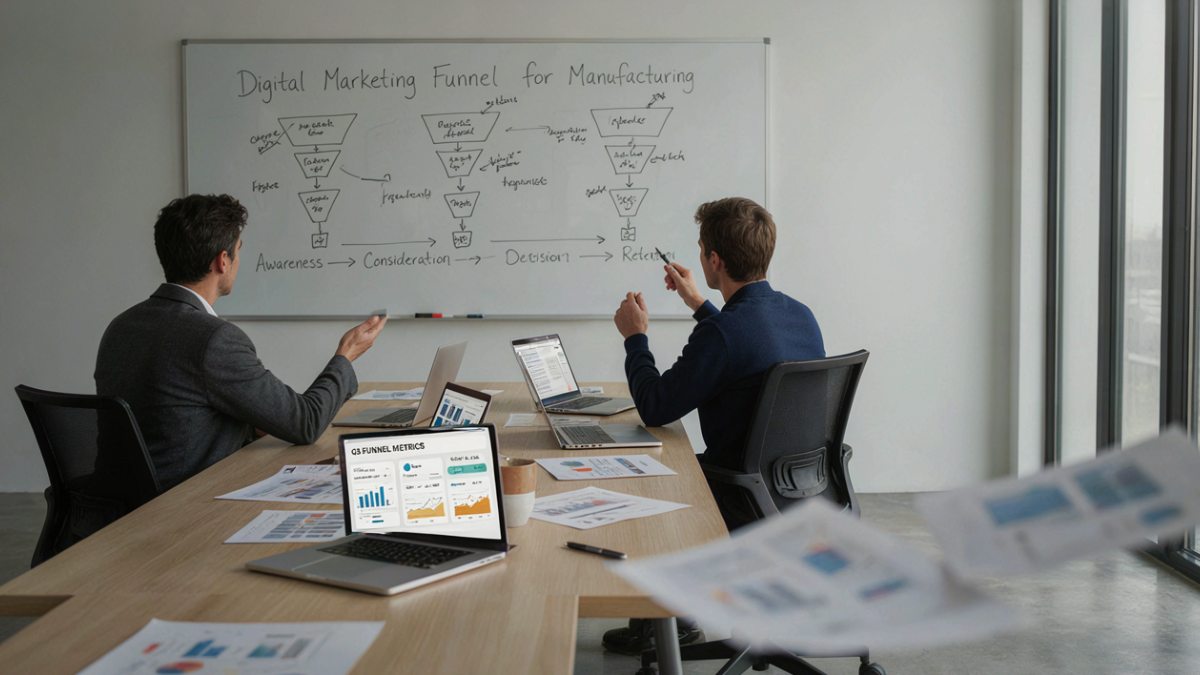
Most manufacturing businesses treat marketing as something that happens after the product is ready. Trade show booth, brochure, cold call list. Then the pipeline feels thin and nobody can explain why.
The product is usually fine. The problem is where buyers look now, and whether your business shows up there at all.
Industrial digital marketing is not about making manufacturers sound like consumer brands. It is about being present when a procurement manager or engineer opens a browser to find their next supplier. That window is shorter than most manufacturers expect. And it is almost entirely online.
Buyers Have Already Shortlisted Before They Call You
Here is the part that surprises people: 57% of industrial buyers make purchase decisions before they ever contact a supplier, according to a 2026 ManufacturingLeadGeneration report. By the time someone picks up the phone, they have read your website, compared your capabilities against competitors, and already formed an opinion.
B2B marketing for industrial companies used to mean a good sales team and the right trade shows. That still has a role. But it now covers a fraction of how buyers actually evaluate suppliers. The majority of the process happens on Google, on LinkedIn, and increasingly inside AI-generated answers on platforms like ChatGPT and Perplexity.
A manufacturer with no real digital presence is not just missing web traffic. They are being removed from shortlists they never knew existed.
Want to see how Skovian has approached this for manufacturing clients? The case studies are here.
What Industrial Digital Marketing Actually Covers
Industrial digital marketing is not a single channel. It is several channels working across the different stages of how a buyer researches and decides. In practice, for a manufacturing business, that breaks down like this:
Search (SEO) Procurement leads search for specific capabilities, not generic categories. “AS9100-certified precision machining” is a search made by someone who already knows what they need. Getting your site in front of them at that point is worth more than ranking for “machining company” with ten times the search volume. According to Web Tonic’s 2026 manufacturing marketing benchmarks, SEO delivers a 2.6% conversion rate for B2B manufacturers, which is ahead of paid ads, paid social, and trade shows.
Manufacturing content marketing Most manufacturers skip this and it is where the biggest gap sits. Manufacturing content marketing means publishing technical content that answers what buyers actually ask: how your process works, what tolerances you hold, which industries you have supplied, what your quality certifications cover. A buyer who reads a detailed process breakdown trusts you before speaking to anyone on your team. A competitor with a five-page brochure site cannot replicate that.
LinkedIn outreach For B2B marketing for industrial companies, LinkedIn is in a category of its own. Procurement managers, plant directors, and supply chain leads are active there in a way they are not on other platforms. Reaching them through targeted content and outreach gets you in front of decision-makers before they are searching, which is cheaper and less competitive than trying to reach them once they are already comparing quotes.
Paid search Organic SEO takes time to build. Paid search covers the gap by targeting buyers who are searching right now. For manufacturers entering a new market or launching a new capability, paid search gets you into consideration quickly while organic rankings develop in the background.
The Content Gap Most Manufacturers Don’t Realise They Have
Most manufacturers already have the raw material for excellent content. Process documentation, quality certifications, application case studies, technical specs, tolerance guides. None of it is published.
This is not a creative problem. It is an operational one. A manufacturer that publishes a detailed guide on how their CNC machining process handles aerospace tolerances will rank for searches a competitor with a generic about-us page will never touch. The gap between what manufacturers know and what they have put online is one of the largest untapped advantages in industrial digital marketing.
Turning that knowledge into structured, searchable content is what moves the needle from “we have a website” to “we get enquiries from the website.”
Not sure where to start? Working with a manufacturing digital marketing agency that understands both the technical side and the search side makes this considerably faster than figuring it out in-house.
Three Places Where B2B Digital Marketing for Manufacturers Falls Apart
When manufacturers say digital marketing is not working, it almost always comes down to one of these
Chasing the wrong keywords. Broad terms like “metal fabrication company” get volume. They rarely get qualified buyers. A buyer searching “custom aluminium extrusion for automotive OEM” is far more valuable, even if that search only happens 200 times a month. Most generalist agencies optimise for the former because it looks better on a report.
Using the website as a brochure. Five pages and a contact form is a minimum viable presence, not a marketing asset. Buyers in 2026 expect capability statements, process details, past project types, and quality credentials before they reach out. A thin website loses the shortlist silently.
Stopping before it has time to work. B2B marketing for industrial companies runs on longer cycles than consumer marketing. Organic content takes three to six months to rank. LinkedIn outreach builds over quarters. The manufacturers who stop at month two never find out what month seven would have looked like, and often conclude that digital marketing does not work for their sector when the reality is they just did not stay long enough.
The Numbers Already Settled This Debate
Industrial digital marketing is not something manufacturers can decide to wait on.
Gartner’s CMO Spend Survey showed manufacturing marketing budgets jumped from 6.7% to 9.5% of revenue between 2024 and 2025. A 42% increase in one year. Digital channels now account for more than half of total marketing spend across industrial firms, overtaking trade shows and print for the first time.
The manufacturers increasing those budgets are not doing it speculatively. They are doing it because it is working. The ones waiting are watching competitors show up in places where they used to be the only option.
Where to Actually Start
There is no universal starting point because it depends on where a business currently sits.
No Google presence? SEO and foundational content first.
Already ranking for core terms but enquiries are not coming? The content needs to convert, not just attract. That is a different problem.
Both of those sorted? The next step is expanding into LinkedIn and AI-visible content before competitors catch up.
The right starting point requires an audit. What does not change is the direction: buyers research online before they contact anyone, and the manufacturer that shows up with specific, credible content wins the consideration more often than the one that does not.
FAQ’s
Your Competitors Are Already in Rooms You Haven’t Entered Yet
The manufacturers showing up consistently in search results, getting cited in AI-generated answers, and staying visible to procurement leads on LinkedIn did not get there by accident. They published what they knew, targeted the right queries, and stayed consistent long enough for it to compound.
That is what industrial digital marketing comes down to. Not exotic tactics. Just showing up where buyers look, with content that gives them a reason to shortlist you.
If your business is not in those rooms yet, the gap is closable. But the longer it stays open, the harder it gets to close.
Recent Posts
- How Manufacturing Companies Can Use Digital Marketing to Win More B2B Clients
- How Professional SEO helps Manufacturing Companies Win More High-Value Clients
- Why Fast-Growing Businesses Invest in Professional Website Development Services
- AI SEO vs Traditional SEO: What Should Businesses Choose in 2026?
- How Skovian’s SEO Services Help Businesses Rank Higher on Google and Generate More Leads