
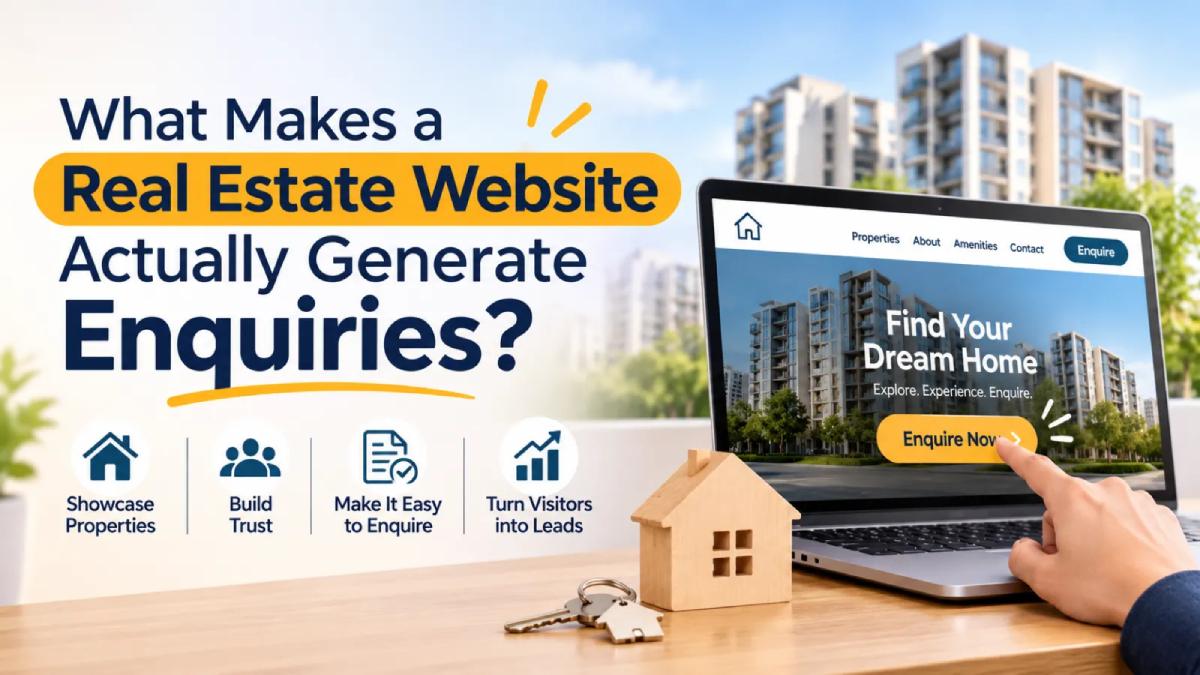
Most real estate websites look the part. Good photos, a clean layout, listings, a contact form. And then almost nothing happens.
Visitors land, scroll, and leave. The phone stays quiet. The form stays empty. Meanwhile, another site, sometimes with worse listings, pulls in leads every week.
The difference rarely comes down to design aesthetics. It comes down to real estate website conversion: whether the site is built to turn visitors into enquiries, or just to look like it should. Getting real estate website design and conversion working together is the problem most property websites have never properly solved. Working with the best SEO company for real estate in Pune to audit that layer is usually what separates the two outcomes.
Traffic Alone Won’t Close the Gap
Real estate websites convert at an average of just 2%, according to Promodo’s Real Estate Marketing Benchmarks 2026. High-performing platforms like Zillow push past 5%. Most agency and developer sites sit well below that, and real estate website conversion is the reason.
That gap doesn’t close by getting more traffic. It closes by fixing what’s happening when visitors arrive.
Real estate website design decisions made years ago, or handed to a developer with no conversion brief, often lock sites into that 2% ceiling. The layout looks professional. The structure works against the visitor at every decision point.
The Listing Page Is Where Most Enquiries Die
A buyer arrives, finds a property they like, and then what? If the only option is a generic enquiry button that opens a form asking for their name, email, and phone number, most will close the tab. They’re not ready for a call. They want to know if this property fits their situation.
Property website best practices treat the listing page as a sales conversation, not a data-entry exercise. That means a headline answering the buyer’s core question, a low-friction contact option like WhatsApp or a callback request, enough information on the page to keep people reading rather than hunting elsewhere, and social proof placed near the form: a testimonial, a recent nearby sale, something that lowers the emotional risk of reaching out.
When those elements are in place, the same traffic converts at a materially higher rate. The visits don’t change. The outcome does.
Why Is Your Homepage Sending People Away?
The typical real estate homepage leads with a hero image, a search bar, and a tagline. Visually it works. Strategically, it sends every visitor into a search flow before they’ve decided they want to browse your listings at all.
Buyers arriving from Google already have something specific in mind. They came because a page title promised an answer. If the homepage redirects them to a generic search tool, most lose the thread and leave.
Real estate website design that converts puts the visitor’s intent first. Different entry paths for buyers, sellers, and developers if your site serves all three. Featured properties selected for their likely-to-convert profile. A value statement in the first fold that gives people a clear reason to stay rather than returning to the search results page.
To see how Skovian approaches this across property and construction brands, explore Skovian’s real estate case studies.
The Mobile Problem Quietly Costing Half Your Leads
According to a 2026 HomeStack study, 76% of homebuyers now search for properties on their phones. Mobile real estate websites convert at around 2.49%, compared to desktop benchmarks that can run twice as high.
That gap is almost entirely a real estate website design problem. Forms that don’t autocomplete. Buttons placed where thumbs don’t reach. Photo galleries that load slowly on a 4G connection. A user experience built for desktop and scaled down rather than designed for mobile from the start.
If your site’s mobile experience is a compressed version of the desktop version, you’re losing more than half your potential enquiries before visitors even consider reaching out.
What Real Lead Capture Looks Like
The contact form is not a lead capture strategy. It’s one option in what should be a broader set.
High-converting real estate sites offer multiple low-commitment ways to start a conversation. A property valuation tool. A neighbourhood guide download. A callback request with a time-slot selector. WhatsApp enquiry.
Each of these asks for less than a phone call but gives the agency something to follow up on. They work because they match where the buyer actually is. Most people viewing a listing at 11pm on a Tuesday aren’t ready to call an agent. They’re ready to compare, bookmark, and ask one question that doesn’t require them to be sold to.
Real estate website conversion and property website best practices both point to the same thing: stop treating every visitor like a hot lead and start building paths for people earlier in the process.
See how Skovian approaches lead generation across industries as one of the lead generation companies in Pune.
How Skovian Approaches Real Estate Website Performance
Skovian works with real estate businesses on the conversion layer most website projects skip: what happens after the traffic arrives.
That covers audit work across property website best practices, real estate website conversion analysis, mobile performance, structured content for search visibility, and lead capture flows built around how buyers actually behave. For property developers and agencies with good-looking sites that aren’t generating enquiries, that audit is usually where the answers are.
The technical side connects directly to SEO. Pages that follow solid property website best practices signal relevance clearly, load fast, and answer the questions buyers are actually asking. Search visibility and conversion share a foundation. Improving one without addressing the other leaves results on the table.
Ready to Turn Your Real Estate Website Visitors Into Enquiries?
If your site gets traffic but not enquiries, the problem is almost certainly one of three things: a listing page that doesn’t give buyers a clear next step, a mobile experience that creates friction at every point, or lead capture that assumes everyone is ready to call.
Start with one. Look at your top three listing pages and ask what a visitor is supposed to do when they finish reading. If the answer isn’t obvious within five seconds, that’s where to begin.
Get in touch with Skovian to talk through what a conversion audit looks like for your site.
FAQ’s
Recent Posts
- What Makes a Real Estate Website Actually Generate Enquiries?
- How to Choose the Right SEO Agency for Your Business (Without Getting Burned)
- Why Your Website Gets Traffic But No Enquiries (And What’s Actually Going Wrong)
- Why Your Business Isn’t Showing Up on Google Maps (And How to Fix It)
- How Manufacturing Companies Can Use Digital Marketing to Win More B2B Clients